Clinical research coordinators (CRCs) are the operational backbone of any oncology trial. They manage screening, consent, scheduling, data entry, adverse event documentation, and a dozen other tasks that collectively determine whether a trial runs smoothly or generates protocol deviations. Adding therapeutic drug monitoring (TDM) to their responsibilities creates a new category of task that most CRC training programs do not prepare them for.
The default response from clinical pharmacologists is to give CRCs a pharmacokinetics primer: one-compartment models, half-life, Vd, clearance, area under the curve. This is usually a mistake. Not because the concepts are wrong, but because the training load is unnecessary for safe operation of a TDM platform, and excess conceptual burden reduces retention of what actually matters.
After working with CRC training programs at multiple trial sites over the past three years, four concepts have emerged as genuinely required for safe, accurate TDM platform operation. Two more are frequently covered in training and genuinely do not need to be.
Concept 1: Sample Timing Accuracy Is Not Optional
The single most common error CRCs make with TDM platforms is entering nominal sample times rather than actual sample times. This is understandable - in most data entry workflows, scheduled time is the standard entry. "Patient was scheduled for a 9:00 AM blood draw" is how clinical events are documented throughout a trial. For TDM, it is wrong.
CRCs need to understand - not at a mathematical level, but at a procedural level - that the dosing system's AUC calculation depends on knowing exactly when each sample was drawn relative to when the infusion started. A 15-minute error in a sample drawn 30 minutes post-infusion is a 50% timing error. The analogy that works well in training: imagine navigating by GPS where the position updates 15 minutes late. For highway driving, the delay barely matters. For parking, you would drive into a wall. Early-phase blood samples are the parking-lot scenario.
The training standard should be: every PK sample entry requires four documented times - infusion start time, infusion end time, sample draw time (from the tube label, not from the nurse's memory), and lab receipt time. These are entered from the source document (infusion pump record and tube label time stamp), not from the scheduled times in the protocol calendar. This distinction should be explicitly covered in the TDM section of CRC training and included in the site's training completion checklist.
Concept 2: The Difference Between Dose Recommendation and Dose Order
TDM platforms generate dose recommendations. They do not issue dose orders. The physician reviews the recommendation and signs an order. This sounds obvious, but in practice, CRCs sometimes interpret a dose recommendation display as an action item for them to coordinate. They call the pharmacy before the physician has reviewed and approved the recommendation - or, more dangerously, they assume an unchanged recommendation from the previous cycle means no physician review is needed this cycle.
Every cycle requires an explicit documented physician review of the TDM recommendation, even if the recommendation is to continue the same dose. The FDA's 21 CFR Part 11 audit trail requirement (covered in our article on 21 CFR Part 11 compliance for dosing software) means that a documented review trail is legally required, not just best practice. CRCs need to understand their role in the workflow: enter data, confirm sample timing documentation, route the recommendation to the responsible physician, and coordinate the pharmacy after written physician approval is documented. They are not in the review chain itself.
Concept 3: What "Within Target Range" Means in Operational Terms
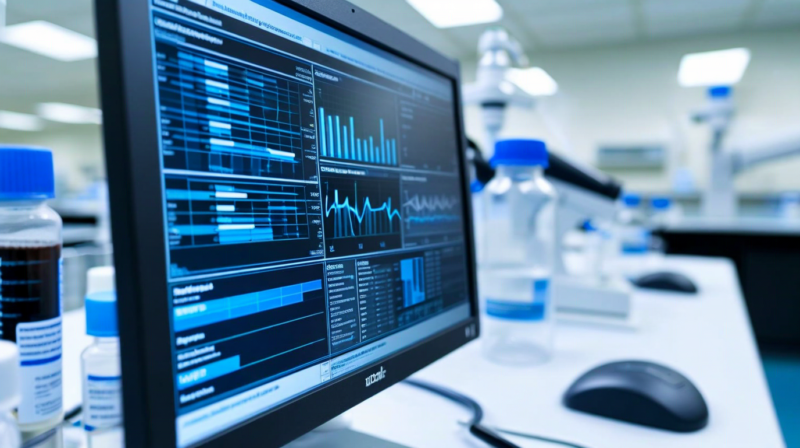
Most TDM dashboards display the current AUC estimate against a target range with visual indicators (green/yellow/red, or text labels like "within target," "below target," "above target"). CRCs use this display to understand where the patient stands, which is appropriate - they need to flag patients outside range for physician attention and document the range status in their visit notes.
What CRCs do not need to understand is how the AUC is calculated. What they do need to understand is: (a) what action is required for each status indicator, (b) who receives notification for out-of-range results, and (c) what the documentation standard is for "within target range" versus "out of range" in the EDC. These three procedural details are what translate TDM software output into correct trial data. The math behind the indicator is the clinical pharmacologist's domain, not the CRC's.
Concept 4: Sample Integrity Requirements
TDM blood samples have specific handling requirements that differ from standard clinical laboratory specimens. Carboplatin samples, for example, should be centrifuged and plasma separated within 30-60 minutes of collection to prevent continued platinum binding to red cell hemoglobin, which will artifactually lower measured plasma concentrations. Most standard CBC or chemistry tubes can sit in the pneumatic tube system for two hours without affecting results. TDM samples cannot.
CRCs are the people who manage sample handling at most sites. The training requirement is specific and procedural: which tube type for which drug, what the centrifuge protocol is, what the maximum time from draw to centrifuge is, and what to do if that window is missed (document it and flag it to the clinical pharmacologist before the AUC calculation is run - a sample drawn 2 hours ago and just now centrifuged should not be entered with its nominal draw time as if it were handled correctly).
Sample integrity failures that are documented are recoverable - the clinical pharmacologist can decide whether to use the data or exclude it. Sample integrity failures that are not documented are permanent data quality problems that may not be detected until the AUC estimates from that patient look inconsistent with the rest of the cohort.
What CRCs Do Not Need to Understand: PK Parameters
Clearance (CL) and volume of distribution (Vd) are the core PK parameters displayed in many TDM platforms. They have real meaning and are useful to clinical pharmacologists. They are not needed for CRC workflow execution. A CRC does not need to know that clearance of 7.4 L/hr is high or low for this patient population, or that a Vd of 11.2 L is consistent with a two-compartment model for this drug. That interpretation is the clinical pharmacologist's job.
Training programs that include PK parameter interpretation for CRCs typically produce one of two outcomes: CRCs who memorize the numbers without understanding them and occasionally misinterpret them, or CRCs who tune out the training section and miss the adjacent procedural content that actually matters. Neither outcome is acceptable. Limit CRC training to the four concepts above and the software's specific workflows. PK parameter interpretation is out of scope.
What CRCs Do Not Need to Understand: Bayesian Estimation
MAP Bayesian estimation is the statistical method behind the AUC calculation in most clinical TDM platforms. Understanding how it works is useful for troubleshooting unexpected results and for evaluating whether a platform's predictions make biological sense. It is not required for CRC-level operation.
The relevant CRC-level knowledge is: the software uses the patient's actual sample results to improve the AUC estimate, so samples that are entered incorrectly (wrong time, wrong concentration) produce worse estimates. If the AUC estimate seems inconsistent with the patient's prior cycles or with the physician's clinical impression, the CRC should flag it for review rather than assuming the platform is correct. This is CRC-appropriate guidance that does not require any understanding of Bayesian posterior distributions.
Structuring the Training Program
An effective CRC TDM training program for a 90-minute session covers: (1) site-specific TDM workflow overview, from sample collection through physician approval through pharmacy coordination; (2) sample timing documentation requirements with hands-on practice entering actual vs. nominal times; (3) sample handling and centrifuge protocol; (4) TDM dashboard orientation - how to find each patient's current AUC status and what the status indicators mean for CRC action; (5) audit trail expectations - what documentation is required at each step and where it lives in the EDC.
The training should include a role-play scenario where a sample is drawn at 9:17 AM, the infusion started at 8:50 AM and ended at 9:10 AM, and the CRC must enter all four times correctly. The scenario should include a common error condition - say, the tube label shows 9:15 as the draw time, but the nurse's note says 9:17 - and the CRC must know which source document takes precedence (the tube label, as the proximate record).
Conclusion: Right-Size the Training for the Role
CRC training for TDM platforms fails when it tries to turn CRCs into junior pharmacokineticists. The goal is accurate, timely data entry and correct workflow execution. That goal is best served by a training program that covers exactly what CRCs need to do - with the four concepts above as anchors - and explicitly excludes the conceptual material that belongs in a different role's training.
DoseMind provides site-specific CRC training materials as part of every trial onboarding package, tailored to the specific TDM workflow, drug, and EDC integration in use at the site. Contact us at [email protected] to discuss your site training needs.